Support
Frequently asked questions
Speed, range, the law in your country, service, ownership — the honest answers, before you ride.
Speed pedelec 101
What a speed pedelec is, and why it changes the ride.
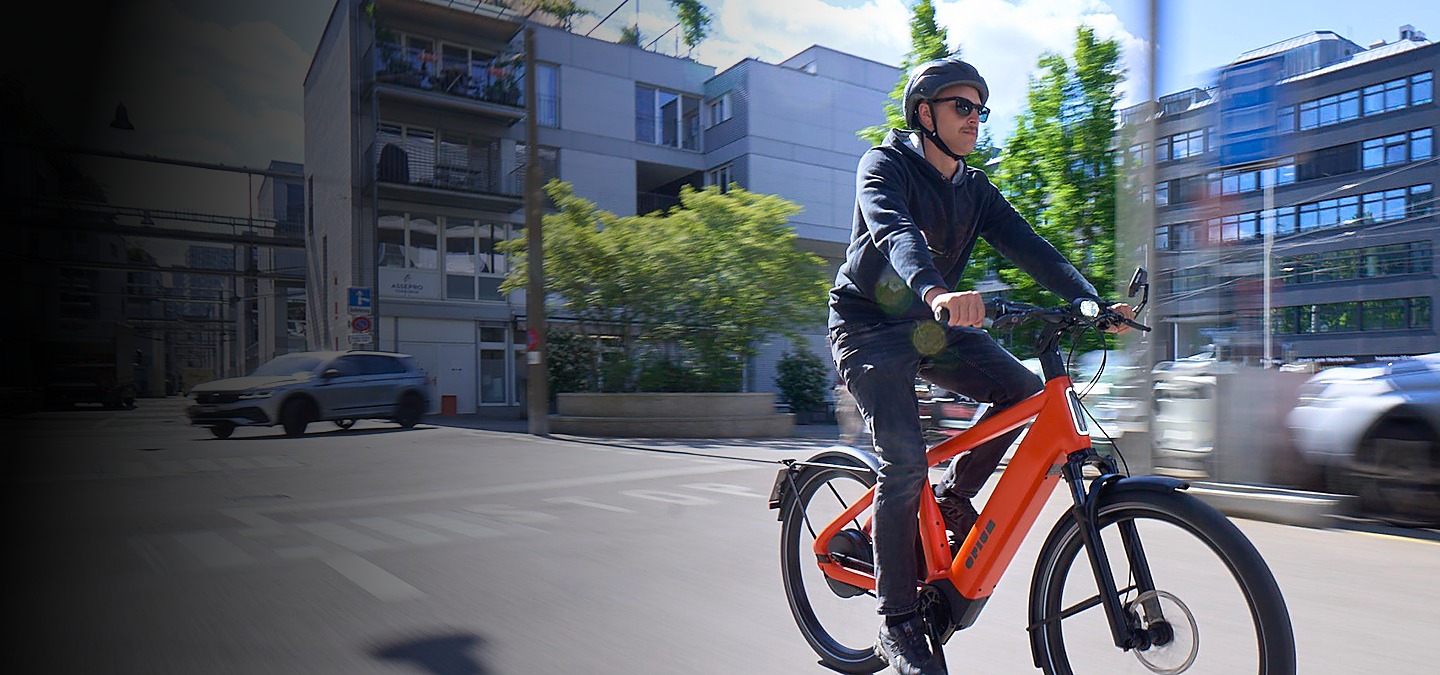
A speed pedelec is an electric bike that assists you up to 45 km/h. You still pedal; the motor amplifies your effort.
Across Europe it’s type-approved as an L1e-B light moped, which is why some road rules differ (see Riding & the law below). Every Opium is a speed pedelec, built for people replacing a car rather than upgrading a bicycle.
Speed and range. At 45 km/h you keep pace with city traffic, and a 40-minute commute becomes 20. Opium batteries are large (up to 2,135 Wh), so you can ride most of the week on a single charge.
If you cover real distances every day, a 25 km/h e-bike starts to feel like the slow lane.
The motor assists you smoothly up to 45 km/h on flat roads and gentle climbs. Past 45 it stops assisting and eases the power off. Downhill you can still go faster under your own weight, but the motor won’t drive you beyond its 45 km/h limit, as EU law requires.
Most speed pedelecs make you trade one thing for another: range for power, or power for low maintenance. An Opium is built to give you all of it. Up to 1000 W, up to 300 km of range from the 2,135 Wh system on the Model S-LR, and a sealed Pinion gearbox with a Gates carbon belt that needs no chain and no oil.
It’s designed and built in Switzerland, and sold through dealers who can service it properly. Ride one, then compare.
On paper it’s a light moped (EU category L1e-B), because it assists beyond 25 km/h. On the road it rides like a bike: you pedal, it responds. The classification mostly affects paperwork, which we break down below (licence, plate, helmet, insurance).
The essentials, across the range:
- Assistance up to 45 km/h
- Motor: up to 1000 W, rear hub
- Battery: 1,060 to 2,135 Wh, depending on model
- Range: up to 300 km (Model S-LR)
- Brakes: Magura hydraulic discs, 203 mm rotors
- Drivetrain: Pinion gearbox and Gates carbon belt (Mechanical or Smart.Shift)
- Full charge: about 8 hours
- Bike weight: from around 38 kg
- Maximum load and rack capacity: see your bike’s manual or ask your dealer
Exact figures depend on the model and how you configure it; the configurator and your dealer have the full spec.
Range & battery
How far you’ll really go, and how charging works.
It depends on a lot of things: your weight and height, the weather, the road, and above all your battery. In ideal conditions, on a full charge, an Opium can cover:
- Model C (1,060 Wh): up to ~125 km
- 1,400 Wh: up to ~200 km
- 1,600 Wh: up to ~230 km
- Model S-LR (2,135 Wh): up to ~300 km
These are best-case figures. Ride at full assist, into a headwind, uphill or in the cold, and the range drops, so plan for the lower end in winter. We quote battery capacity in Wh rather than optimistic range numbers, so you can compare honestly.
On the Model C, yes. Its 1,060 Wh battery lifts out, so you can carry it inside and charge it at your desk or in your flat.
On the Model T2, Model S2, Model L and Model S-LR, the battery is built into the frame for stiffness and full weatherproofing; you charge those from any wall socket with the bike beside it. The Model S-LR’s range extender also comes out and can be charged on its own.
From any standard wall socket. No special installation, no wallbox. A full charge takes around 8 hours across the range, so most riders top up overnight or at the office and rarely run a battery flat.
You keep going. With an empty battery an Opium rides like a normal bike: the display and lights stay on, you just lose the motor assistance. You’ll always make it home.
Several years of normal riding. The battery is part of the FIT system and carries FIT’s own 2-year warranty; life beyond that depends on how you charge, ride and store it. Your dealer checks battery health at every service.
Yes. Like any lithium battery, it loses some capacity in the cold, so winter range is lower. Store the bike (or the Model C’s battery) indoors when it’s freezing, and start your ride with a battery near room temperature for the best range.
Riding & the law
A speed pedelec is a light moped, so the rules differ by country. Here’s the essentials for every market we sell in.
Yes, in every market we sell in: Switzerland, Belgium, the Netherlands, Germany, Denmark and France, as long as you meet that country’s speed-pedelec rules. Because an S-pedelec is a light moped, those rules differ. Here’s the picture at a glance:
| Country | Min. age | Licence | Helmet | Plate / registration | Insurance | Where to ride |
|---|---|---|---|---|---|---|
| 🇨🇭 Switzerland | 14 | Cat. M (or higher) | Yes — bike helmet accepted | Yellow plate + annual vignette | Yes — via the vignette | Cycle paths where present; motor off where mopeds are banned |
| 🇧🇪 Belgium | 16 | AM (or B / A) | Yes — with temple/rear coverage | SP plate (register with DIV) | No separate moped policy since 2019; family liability recommended | Roads ≤50 km/h: your choice; >50: use cycle path; match the local limit |
| 🇳🇱 Netherlands | 16 | AM (or car B) | Yes — speed-pedelec (NTA 8776) or moped helmet | Yellow moped plate | Yes — moped liability (WA) | Road; moped/snelle-fiets path where signed (not normal bike paths) |
| 🇩🇪 Germany | 16 | AM (or car B) | Yes — a suitable helmet | Yearly insurance plate | Yes — liability (Haftpflicht) | Road only — cycle paths forbidden unless signed |
| 🇩🇰 Denmark | 15 | None from 18 (AM under 18) | Yes — bike helmet | None required | Yes — liability | Cycle path |
| 🇫🇷 France | 14 | AM (or car B) | Yes — motorcycle/moped helmet | Register (ANTS) + plate | Yes — moped liability | Road only — cycle paths forbidden unless signed |
Rules are current as of mid-2026 and simplified for guidance. They change and vary by region, so confirm the details with your Opium dealer or local authority before you ride. This isn’t legal advice.
In most markets, yes, though it’s modest. A moped licence (category AM, or category M in Switzerland) is the baseline, and a normal car licence (B) covers you in Belgium, the Netherlands, Germany and France. Denmark asks for no licence once you’re 18. Minimum age: 14 in Switzerland and France, 15 in Denmark, and 16 in Belgium, the Netherlands and Germany.
Always. A helmet is mandatory in all six markets; only the type changes. A normal bike helmet is fine in Switzerland and Denmark, and in Belgium if it adds temple and back-of-head coverage. The Netherlands wants a certified speed-pedelec (NTA 8776) or moped helmet, and France requires a homologated motorcycle or moped helmet.
If you’d rather buy once, an NTA 8776 speed-pedelec helmet is accepted almost everywhere. Your dealer can fit one.
A plate or registration is needed in Switzerland (yellow plate plus an annual vignette), Belgium (an SP plate, registered with the DIV), the Netherlands (yellow moped plate), France (registration via ANTS) and Germany (a yearly insurance plate). Denmark is the exception: no plate, no registration.
Liability cover works differently per country. In Switzerland it comes with the vignette, in Germany with the insurance plate. In Belgium, a pedal-assist speed pedelec (every Opium) hasn’t needed a separate moped policy since 2019; your family liability insurance covers it, and we’d recommend having one. Your dealer walks you through the exact steps for your country.
This is the one that varies most. In Denmark you ride on the cycle path. In Germany and France you ride on the road, and cycle paths are off-limits unless a sign says otherwise. Switzerland, Belgium and the Netherlands sit in between: use the cycle path where it’s signed for speed pedelecs, and match your speed to the local limit. When the signs don’t say, the road is usually your place.
It depends on the country and how the bike is set up. A speed pedelec is a moped, so the rules on passengers and child seats are stricter than on a bicycle (Denmark, for one, bans a child seat and trailer under its scheme). Ask your dealer what’s allowed and how to fit it safely before you carry anyone.
Buying, leasing & test rides
Choosing, trying and paying for your Opium.
Through our specialist dealers across Switzerland, Belgium, the Netherlands, Germany, Denmark and France. They handle the fit, the registration, the servicing and any warranty work, which is most of what matters on a bike you ride every day. Find your nearest one on the Where to Buy map.
Yes, and you should. An Opium makes more sense in five minutes of riding than in any spec sheet. Many dealers keep demo bikes, including Smart.Shift models, so use the Where to Buy map to find one with the model you want. If you’re not sure which Opium fits you, start with the bike finder.
Which Opium is right for you comes down to how you’ll use it. The bike finder narrows it down in a couple of minutes, and each model’s product page covers the detail.
It depends on the model and the options you choose. The configurator gives you an estimate, and your dealer confirms the final price. Opium bikes are premium, but to buy and to run they cost a fraction of a car.
Yes to both. Every Opium is built to order, so you choose how yours is configured before we build it: frame (Diamond or Low Entry), drivetrain (Mechanical or Smart.Shift), battery, fork, saddle and display.
Colour is where it gets personal, with 18 finishes to pick from. Set yours up in the configurator, and your dealer confirms the final spec and price.
Yes. Opium and its dealers work with leasing partners, and in several markets you can put one on a company bike plan or salary scheme. Try the bike-allowance calculator to see your net cost, or ask your dealer or employer.
Usually 4 to 6 weeks. Every Opium is built to order (we don’t hold stock), so if a component is in short supply it can take longer, which isn’t always in our hands. Your dealer gives you the current estimate when you order.
Service & ownership
Living with an Opium — maintenance, warranty and the everyday.
Not much. The Gates carbon belt does away with a greasy chain, and the sealed Pinion gearbox and hubs barely need attention; a rinse with low-pressure water keeps them clean. Plan on one dealer service a year, or about every 10,000 km, where a specialist checks the brakes, updates the software and looks over the battery.
At your Opium dealer. They have the tools, the parts and the training for it.
Every Opium comes with a multi-year manufacturer’s warranty, and registering your bike after purchase extends the cover.
The motor, battery and display are made by FIT and carry their own manufacturer’s warranty, which your dealer handles for you. Full terms are in the Opium warranty policy, and this sits on top of your statutory consumer rights rather than replacing them.
A hose or low-pressure water is fine; the bike is built to shrug off weather. Never a high-pressure jet, though: it drives water past the seals on the motor, battery and bearings. Low pressure and mild soap is all it needs.
Yes. An Opium weighs around 38 kg, so use a rack rated for e-bikes and check its load limit before you carry two. It’s fully weatherproof, so rain on the motorway won’t hurt it.
Yes. The Opium cockpit and the adjustable stem let you move from a sporty position to a more upright, comfortable one, and your dealer can set it to fit you.
The company
Who builds Opium, and what we stand for.
Opium is the e-bike brand of Revolt Zycling AG, based in Fehraltorf, Switzerland. The bikes are developed, engineered and made in Switzerland, with a focus on the parts that have to last: the battery, the gearbox, the brakes.
It’s a challenge. For most daily trips, an Opium does what your car does: quicker through traffic, no fuel, no parking, no bill, and a lot more fun. Not an upgrade to your bike. A replacement for your car.
It’s built for it. Every Opium runs Magura hydraulic disc brakes on 203 mm rotors, strong lights and a frame stiffened for the speed. Put the helmet on, ride to the conditions, and 45 km/h feels natural rather than fast.
Still deciding?
The spec sheet only gets you so far. Book five minutes on one and you’ll understand the rest.
#yournextcar™