Fork Safety on Speed Pedelecs: Why Testing Beyond Regulation Matters

Speed pedelecs are not just faster bicycles — they are vehicles that demand much more from key components such as the fork or wheels. Higher speeds, higher system weight and stronger braking forces mean that parts are exposed to significantly greater stress over time.
Because of that, safety in this category requires more than simply meeting baseline regulations. Regulations are important, but they represent a minimum threshold. For speed pedelecs, we believe it is essential to test further than what the regulation requires — and to validate components in a way that reflects real-world use.
This article explains how Opium approaches fork development and testing, and why small details matter more than most riders realise.
1) A speed pedelec puts the fork under a different kind of stress
A fork is one of the most safety-critical components on any bike — but on a speed pedelec, it faces additional forces that build up over time.
Every ride exposes the fork and steerer tube to a mix of stresses, including:
- strong braking forces,
- torsion (twisting forces) during cornering,
- repeated impacts from road imperfections,
- and fatigue over thousands of kilometres.
It’s not just about surviving one hard stop or one pothole. It’s about staying strong and reliable after countless stress cycles, year after year.
That is why speed pedelec components require a higher safety margin than what typical bicycle standards were originally built around.
2) Testing beyond regulation is essential
Regulations exist to define a baseline level of safety — and that baseline is necessary.
But speed pedelecs are used differently. They are often ridden daily, at high speeds, in all weather conditions, and over long distances. They also experience more frequent high-load events (hard braking, aggressive cornering, high mileage commuting).
For speed pedelecs, it’s important to test further than what the regulation requires. In our view, “passing the test” should never be the end of the engineering story — it should be the beginning.
3) Engineering a safe fork is an iterative process
At Opium, safety is not a claim. It’s a process.
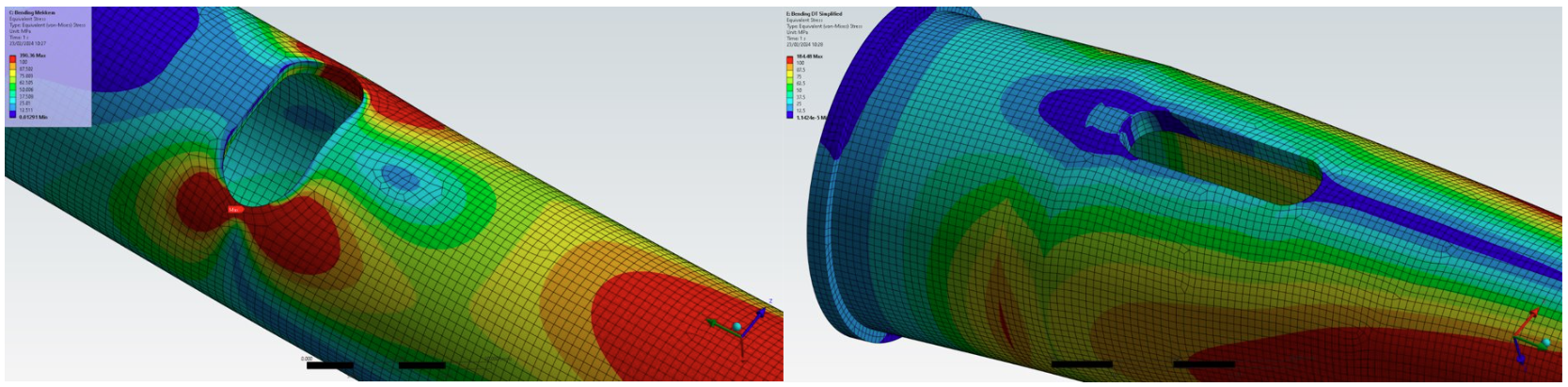
That’s why we work closely with Swiss-based engineering companies to develop, simulate, and validate our designs. The development cycle is intentionally iterative. We design, simulate, modify, simulate again, and repeat until the construction meets our internal requirements.
This loop matters because it allows us to identify stress concentrations early, improve the geometry, and validate the effect of every modification before moving forward.
Only once the design is validated digitally do we move to prototyping.

4) Cable-routing holes: the smallest detail with the biggest impact
Modern bikes require integrated cable routing. That often means creating openings inside structural parts such as the steerer tube.
This is where engineering precision becomes critical.
Cable holes placement has great impact on the solidity of the fork. Even tiny changes in the size or position of an opening can change how forces travel through the material.
One millimetre too big, or too high/low, can make or break a fork.
That’s not marketing language — it’s mechanical reality. When you introduce an opening into a structural tube, the geometry must be engineered so the structure maintains its integrity over time under torsional forces and repeated load cycles.
This is why Opium’s steerer construction and cable-routing solution are designed around long-term structural strength — not just packaging or aesthetics.

5) From prototype to real-world validation
Simulation is essential, but it is not enough on its own.
Once a prototype is ready, we move to physical testing — because real-world loads can reveal behaviours that simulations may not fully capture, especially over long-term fatigue cycles.
To ensure our testing goes beyond standard requirements, we work with specialised testing companies such as Zedler in Germany. Their role is to validate components under extreme loads and confirm performance beyond what normal regulation requires.
This step is crucial because it provides independent, professional verification of the design.
Conclusion: why this matters
When you ride a speed pedelec, you’re riding a high-performance vehicle. That performance should never come at the expense of safety.
For us, the difference is in the details — and in the process.
Testing beyond regulation, iterative simulation with Swiss engineering partners, precision around cable-routing openings, and independent validation through companies like Zedler are not “nice to have”. They are essential.
This is how Opium designs for real speed pedelec loads, real commuting mileage, and long-term durability.
If you have questions about the construction of your Opium bike or want more technical details, our team is always here to help.
Ride safe,
The Opium Team